“I’ve battled demons that won’t let me sleep / Called to the sea but she abandoned me.”
— Sia, “Never Give Up”
Have you ever watched a film that didn’t just entertain you, but left you quiet, full, and a little broken?
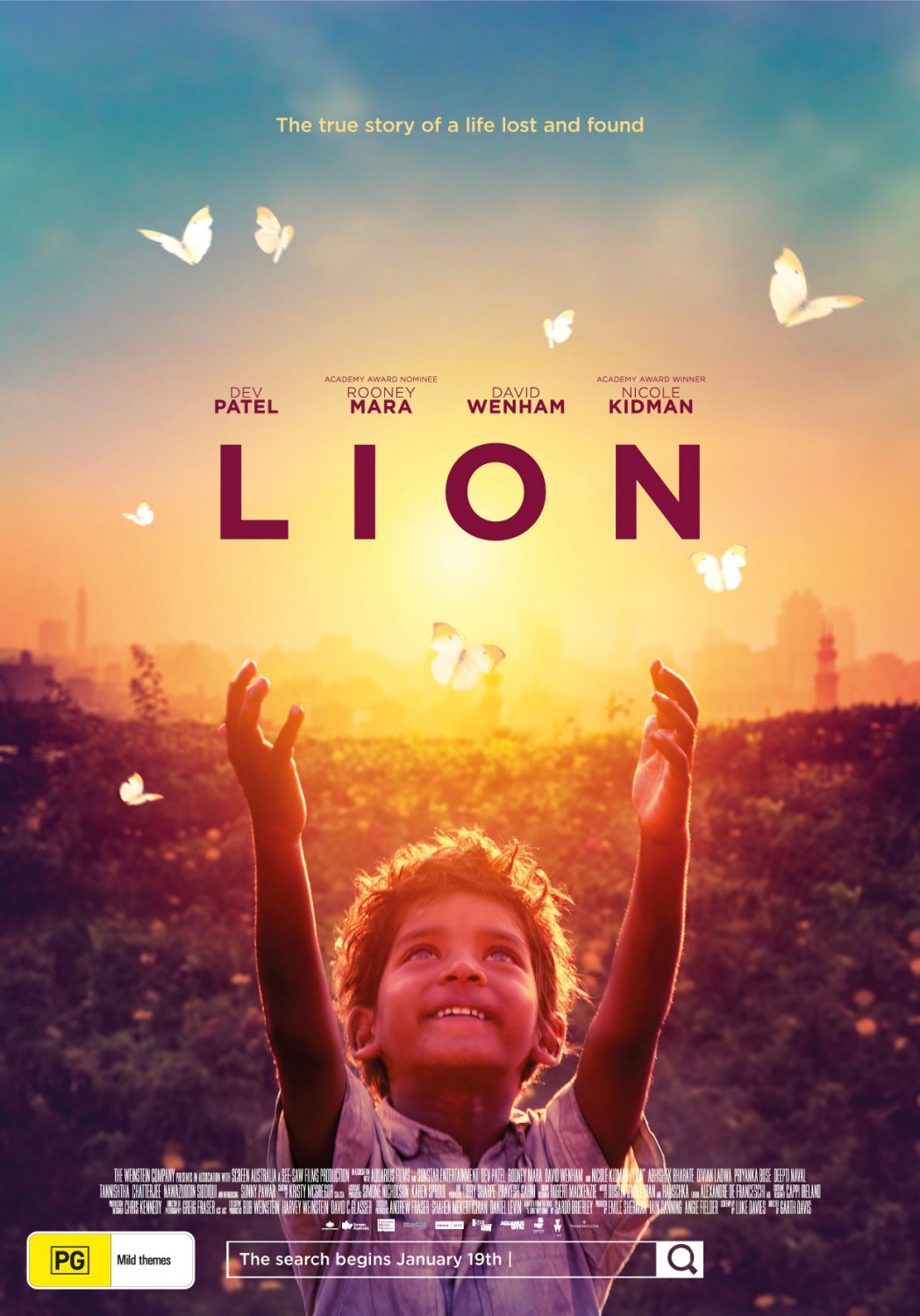
I finally watched Lion — and I honestly don’t know where to begin.
It’s one of those rare films that doesn’t just tell a story — it stays with you. Even after the screen goes black, the emotions continue swirling inside. I thought I was prepared for the emotional weight (I mean, I’d heard people talk about it), but nothing really prepares you for the quiet heartbreak this film delivers.
The Plot (But It’s So Much More Than a Plot)
Based on a true story, Lion follows the journey of Saroo, a five-year-old boy from a small village in India who accidentally boards a train that takes him over 1,600 kilometers away from home. He doesn’t know the name of his village or even how to speak the local language in Kolkata. He ends up alone, vulnerable, and eventually in an orphanage — before being adopted by an Australian couple.
Fast forward 20+ years, and Saroo (now grown and played by Dev Patel) begins a new journey: one of rediscovery, memory, identity, and longing. Using fragments of his childhood memories — a water tower, a train station, a few landmarks — and the relatively new tool called Google Earth, he begins searching for the home he lost.
Sounds simple, right? But watching it unfold? Heart-wrenching.
As Someone From India, It Hit Harder
Being Indian, this film resonated on a deeper level. The early scenes — the train platforms, the street children, the hunger, the chaos, the kindness and danger coexisting — felt hauntingly familiar. It wasn’t romanticized or exaggerated. It was just real.
There’s a specific kind of heartbreak that comes from watching a child get lost in a place that looks like the places you pass through every day. And then knowing that this isn’t just a story — it happens here. Still. All the time.
The Performances? Unforgettable.
Sunny Pawar as young Saroo? Absolutely incredible. He’s barely speaking for much of the film, but he conveys so much — fear, curiosity, confusion, resilience — all through his expressions. He anchors the first half of the movie and completely pulls you into his world.
Dev Patel takes over the second half with a more internal struggle — the guilt of having lived a comfortable life while his birth family might still be suffering. His emotional breakdown scenes? Devastating. You feel the weight of two worlds crashing inside him.
And Nicole Kidman deserves a special mention. She plays Saroo’s adoptive mother with such warmth, strength, and quiet pain. Her monologue explaining why she adopted — I had chills.
The Ending and That Music…
The moment the real Saroo appears at the end — with both his mothers — broke me. There’s no way to watch that and not cry. But what tied it all together perfectly was the song that played as the credits rolled: “Never Give Up” by Sia.
It’s more than a song — it’s a reflection of Saroo’s journey. It felt like a whispered message to everyone who’s ever felt lost, literally or emotionally. That’s when I realized: Lion is not just about finding home. It’s about not giving up when you’ve forgotten what home even looks like.
Behind-the-scenes facts about the real Saroo Brierley
1. Saroo Brierley was only 5 years old when he got lost
In 1986, Saroo accidentally boarded a train while waiting for his older brother at a local station in India. He fell asleep on the train and ended up in Kolkata (Calcutta) — over 1,600 km away from his hometown. He didn’t know the name of his village, couldn’t speak Bengali, and was too young to explain where he came from.
2. He survived on the streets of Kolkata for weeks
Saroo lived on the streets as a child, begging for food and escaping danger multiple times. He was eventually taken to a government orphanage and later adopted by an Australian couple, Sue and John Brierley, who raised him in Tasmania.
3. Google Earth helped him find his way home
In his late 20s, Saroo began using Google Earth to try to find his birthplace — relying only on his memory of the train ride and a few landmarks. He spent years scanning satellite images, estimating distances and following railway lines out of Kolkata until one day, he found a familiar water tower and landscape. It led him to his home village: Ganesh Talai, near the town of Khandwa in Madhya Pradesh.
4. His biological family thought he was dead
When Saroo finally returned to his village after 25 years, he discovered that his mother had never stopped looking for him. Tragically, his older brother Guddu, who was with him the night he went missing, had died in a train accident that same night. The family assumed Saroo had died too.
5. He wrote a memoir called A Long Way Home
Saroo’s story was published as a memoir in 2013, titled A Long Way Home, which became an international bestseller. The book served as the basis for the film Lion, and gave deeper insight into his emotional journey, struggles with identity, and the guilt he felt growing up away from his Indian roots.
6. Why is the movie called Lion?
The name “Saroo” is actually a misheard pronunciation of his real name: Sheru, which means “lion” in Hindi. When he was adopted in Australia, authorities recorded his name as Saroo, based on how it sounded. This is also the metaphorical heart of the story — a lion cub finding his way back to the pride.
7. Saroo Brierley was deeply involved in the film
Saroo worked closely with the filmmakers and actors during the production of Lion. He met with Dev Patel, who played him in the film, and shared personal details and emotional insights to help make the portrayal as authentic as possible. He also appeared in the final moments of the film, during the real-life reunion footage.
8. He still has strong ties to both his families
Today, Saroo continues to maintain a close bond with both his Indian and Australian families. He visits India regularly and is actively involved in charity work, especially for missing children and families affected by poverty and displacement.
Why You Should Watch It (If You Haven’t Yet)
This is not just a movie. It’s an experience. A reminder of how fragile life can be, how powerful memory is, and how love — from a mother, a brother, a family, or even from strangers — can guide you through the darkest of times.
Lion doesn’t need big speeches or dramatic twists. It thrives in silence, in emotion, in honesty. And it reminds us that sometimes, even after decades, your heart can still find its way home.
Let’s Talk:
- Have you seen Lion?
- Did you cry at the ending (be honest — I did)?
- What part of the movie stuck with you the most?
Leave a comment — I’d genuinely love to hear what you felt. Because this is the kind of film that deserves to be felt, not just watched.