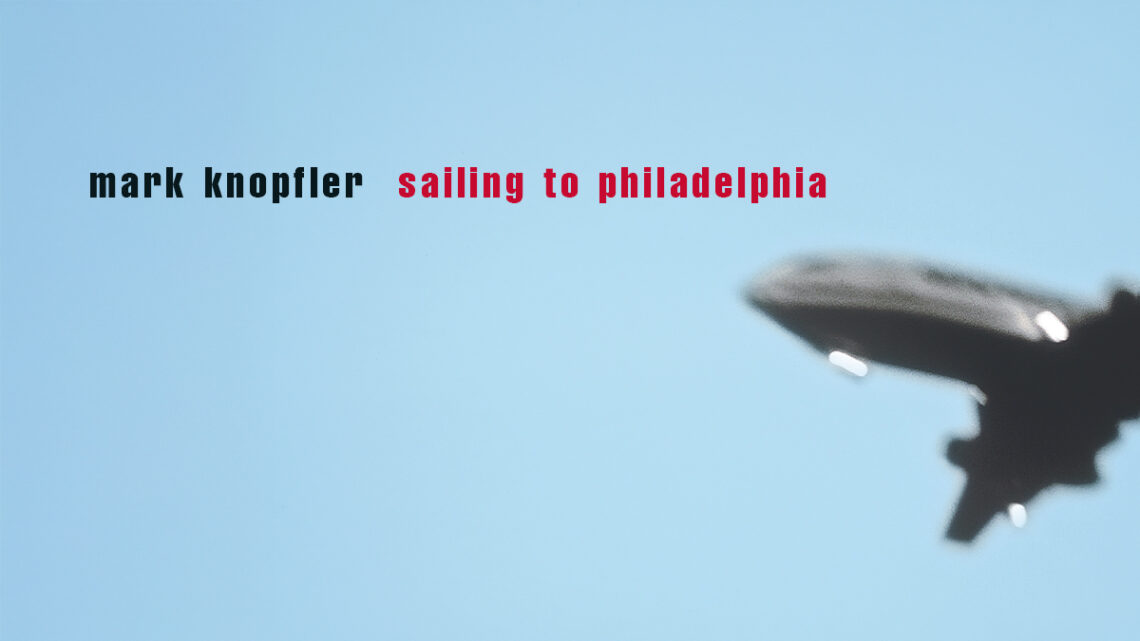
After a break, today I came here to write an another famous song of the legendry singer Mr. Mark Knopfler. Some songs don’t hit you immediately. They wait. Sailing to Philadelphia is one of those songs for me.
Released in 2000 as the title track of Mark Knopfler’s second solo album, Sailing to Philadelphia stands as one of his most understated yet enduring works. It’s a song about exploration, but not conquest; about ambition, but not triumph. Above all, it’s about the human cost of drawing lines on an empty map.
The first time I heard it, nothing dramatic happened. No big chorus, no explosive guitar solo, no obvious emotional hook. And yet, years later, it’s a song I return to again and again—usually late at night, usually when I’m in a reflective mood. It feels less like listening to music and more like stepping into a quiet conversation that’s been going on for centuries.
A Song Built on Voices, Not Volume
Musically, Sailing to Philadelphia is restrained to the point of humility. The arrangement is sparse: clean guitar lines, gentle percussion, and a drifting rhythm that feels like slow movement across water. Knopfler resists drama, allowing space to do the emotional heavy lifting.
What elevates the track further is the duet with James Taylor. The contrast between Knopfler’s gravelly, conversational delivery and Taylor’s warm, reflective tone mirrors the song’s narrative structure—two men, two perspectives, one shared journey. It feels less like a performance and more like a quiet exchange between old friends.
Mark Knopfler has always had a way of sounding unhurried, and in this song, that quality becomes the point. The music moves slowly, like a ship cutting through still water. Every note seems deliberate, as if rushing would break the spell. When James Taylor’s voice joins in, it feels like another traveler has come on deck—not to entertain, but to share the silence.
Surveyors Instead of Heroes
What draws me in most is the story. The song is inspired by Mason & Dixon, but you don’t need to know the novel to feel its weight. These aren’t heroes or conquerors; they’re surveyors. Men sent to draw a line across land they don’t truly own, shaping a future they’ll never see. Men whose job is to measure, observe, and record. Their greatness lies not in glory, but in precision. I find something deeply human in that—doing precise, careful work without fully understanding the consequences.Knopfler makes a deliberate choice here: instead of generals or revolutionaries, he centers the story on surveyors.
Lyrically, the song takes inspiration from Thomas Pynchon’s Mason & Dixon, focusing on the British astronomers Charles Mason and Jeremiah Dixon as they travel to America to draw the boundary that would later define states and ideologies.
The song subtly captures:
- The loneliness of long journeys
- The moral unease of shaping someone else’s land
- The tension between scientific objectivity and human consequence
There is no celebration of empire here. Only the quiet realization that lines drawn with care can still divide lives forever.
Time as an Underlying Current
One of the song’s most powerful themes is time—how it stretches, folds, and echoes. As listeners, we know what Mason and Dixon cannot: that their work will ripple forward into centuries of conflict, identity, and division. That dramatic irony gives the song its haunting quality.
Listening to it, I can’t help but think about how casually borders exist today, how permanent they seem. And yet, this song reminds me that every line on a map began as an idea, measured by tired men under unfamiliar stars. There’s a quiet sadness in that realization. Knopfler doesn’t judge them, and neither do I. He simply lets their uncertainty breathe.He trusts the listener to feel it. That trust is one of his greatest strengths as a songwriter.
Knopfler at His Most Literary
For longtime Dire Straits fans, Sailing to Philadelphia marks a clear evolution. The sharp characters and urban wit of earlier songs give way here to something more literary and reflective. This is Knopfler as novelist rather than reporter—interested less in what happens than in what it means.
It’s no coincidence that this song resonates deeply with writers, historians, and quiet thinkers. It treats history not as spectacle, but as lived experience.
The lyrics never spell everything out, and I appreciate that. They trust me as a listener. The song doesn’t tell me what to feel—it lets me arrive there on my own. Over time, I’ve started hearing it not just as a historical piece, but as a meditation on responsibility. How often do we do things that seem small and technical in the moment, only for them to echo far into the future?
Why the Song Still Matters
In a world still obsessed with borders, ownership, and identity, Sailing to Philadelphia feels quietly relevant. It reminds us that behind every line on a map were people who doubted, wondered, and perhaps regretted what they were creating.
It’s a song best listened to slowly—preferably alone, preferably at night—letting the guitars drift and the words settle.
Because some journeys don’t need a destination to be meaningful. They only need reflection.
I think that’s why Sailing to Philadelphia stays with me. It’s not loud enough to demand attention, but it’s honest enough to earn it. In a world full of noise, it feels brave to be this restrained.
When the song ends, it never feels finished. It feels like the ship is still moving, the line still being drawn, the consequences still unfolding. And maybe that’s why I keep pressing play—because some songs don’t want applause. They just want company.
So, just go to the song, Press play on Sailing to Philadelphia.
Now pause for a moment and ask yourself: where does this song take you first—across water, or back in time?
That’s the quiet power of Mark Knopfler’s writing. This isn’t a song you simply listen to. It’s a song you enter. Love to see your comment…on the song..